Disclaimer: This is more than anything just a sort of dumping ground for references on the origin of the term “experimental film”, and not a definitive history or investigation per se. I would love to receive other references and info on this topic if you feel like contributing them!
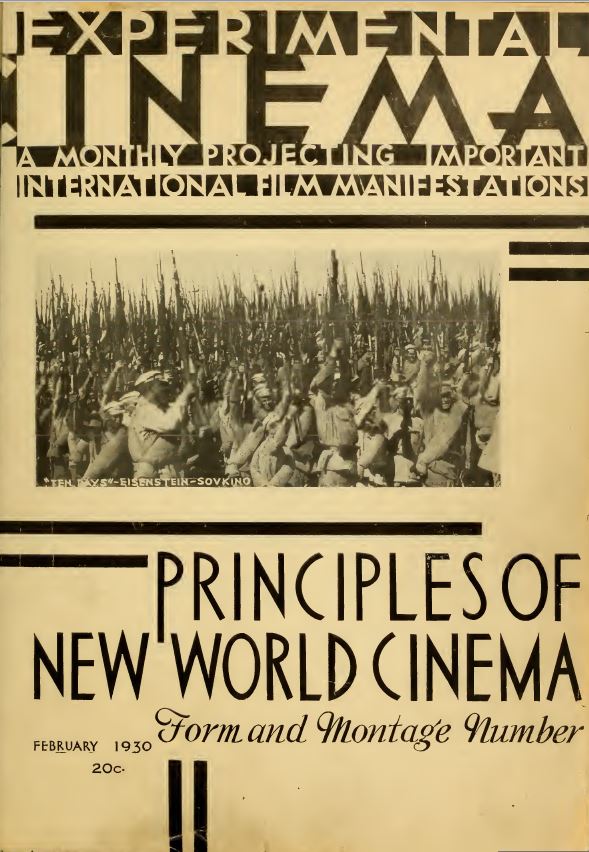
I’ve idly wondered for years when the term “experimental film” came into common usage, and beyond that, when and where it originated from, not that I expect there’s any simple answer to these mysteries. Of the various terms sometimes given to this… er… “area” of filmmaking, “experimental film” is the one that has probably been the stickiest and most widely accepted, even though some folks don’t use it or care for it and prefer other terms. Some understandably don’t see the point in categorizing it at all, but imperfect though it may be, the term is used very widely and what it designates is more or less commonly understood, even if the definition is extremely amorphous and open.
I’m sure plenty of film scholars and enthusiasts have looked into this already, and I’m probably duplicating information here, but it still seemed worth having a small page devoted to the question on this site.
pre-1930
Would love to find references before 1930 on the usage of this term, especially if (as I suspect) it was in use in France in the 1920s (as “cinéma experimental”, I imagine).
1930
It seems reasonably possible that — at least in English — the term originates with and was somewhat popularized and codified by Lewis Jacobs, who published a monthly magazine with Seymour Stern and other contributors called Experimental Cinema between 1930 and 1934, although the magazine didn’t cover what we normally think of today as “experimental film”. Subtitled “a monthly projecting important international film manifestations”, in its five published issues the magazine focused on what would be more accurately considered radical/political/art cinema from an anti-capitalist, politically activist, leftist perspective, with special attention paid to the work of Soviet filmmakers. According to the magazine itself, “Experimental Cinema, founded in 1930, represents the pioneer attempt to establish a film art in America. Its appearance has inspired the formation of innumerable film groups, film societies, film forums, etc., whose policies it has influenced. This magazine, with its tireless educational activities, is largely responsible for the growth of the new film movement in the United States today.”
1939
In Lewis Jacobs’ 1939 book, The Rise Of The American Film (A Critical History), beyond referencing the then-defunct Experimental Cinema magazine, he refers to a few filmmakers such as James Sibley Watson and Mary Ellen Bute as “experimental”, but the only reference to the phrase “experimental film” is actually in the book’s index, though the term “experimental” does here refer to films in what we would now consider a classic, “experimental filmmaking” mode.
However, in subsequent essays over the ensuing years, Lewis Jacobs would employ the term “experimental cinema” and “experimental film”, referring more to the kind of short (usually) independent, often 16mm avant-garde films that are more commonly associated with the term today.
1946
Frank Stauffacher and Richard Foster refer to “the experimental film” in the October 1946 introduction for Art in Cinema: A Symposium on the Avantgarde Film (1947, edited by Stauffacher).
1947
Sara Kathryn Arledge contributed an essay entitled “The Experimental Film: A New Art in Transition” to the Summer 1947 issue of The Arizona Quarterly. Arledge’s essay does define the concept of “experimental film” in terms of what is commonly understood today, citing examples of films by Hans Richter, Viking Eggeling, Charles Dockum, Man Ray, Buñuel & Dalí, and others.
1948
In Hollywood Quarterly, Winter 1947-1948: Vol. 3 No. 2, Lewis Jacobs featured the first part of an essay entitled, “Experimental Cinema in America”, with part 2 of the essay appearing in the following issue (Vol. 3, No. 2). The complete essay is noted in these instances as being planned for inclusion in a forthcoming book entitled The Experimental Film. This book, edited by Roger Manvell, was published in the UK in 1949 as Experiment in the Film, and also features an essay by Jacques B. Brunius entitled (in its English translation) “Experimental Film in France”. Jacobs’ complete essay, ultimately entitled “Experimental Cinema in America 1921-1947”, also appears in a revised version of Jacobs’ own The Rise Of The American Film (A Critical History).
1953
In Robert Breer’s 1953 film Form Phases III, the onscreen titles describe the work as “an experimental film”.
1955
The very first issue of Jonas Mekas’s pioneering journal Film Culture, from January 1955, employs the term “experimental film” throughout in contributions by various authors, suggesting that at least by this point, the term was in widely understood common usage.
 LIGHTSTRUCK