(1954-2013)
THE DREAM (A NEUTRAL NECESSITY) (1981)
16mm, bw & color, sound, 6.5m
THE SELVES (1982)
16mm, color, sound, 10m
“I had an idea for quite some time for a film based on an essay by Lewis Thomas taken from a book that Will [Hindle] had lent me. It was called The Selves and I had shot a couple of test rolls. They were awful. I was too shy to ask someone to be in the film… so I was trying to set up the camera and then perform as well. Disaster.
“After hearing the music [“the sound track of a stage production of Rashomon] I confessed that I had begun a film that could be a perfect compliment [sic] to one of the tracks he had just played for me. But… I added my test rolls had rendered remarkably horrid results. He asked to see the material. I shuttered [sic] at the thought.
“He only needed to see the first roll to understand the dilemma. There was only one other woman in the MFA Film Program at USF at the time… perhaps she could stand in as the figure… if I could only gather the nerve to ask for her help. It was an option even though I knew how busy people’s lives were. An actress was out of the question… I needed a figure… like in a painting… not an actor. Will had a different suggestion. I could direct him as cinematographer… perhaps this could give him a creative jolt useful to his own filmmaking. He promised he would easily take my direction. Of course… he lied.
“We bickered during the entire shoot.” (MF)
OTHER VOICES, OTHER VIEWS (1983)
16mm, color, sound, 7.5m
ONE (1984)
16mm, color, sound, 1.5m
INVITATION TO THE DANCE (1984)
16mm, color, sound, 10m
TROPICAL DEPRESSION (1987)
16mm, bw & color, sound, 10m
LEFT HANDED MEMORIES (1989)
16mm, bw & color, sound, 15m
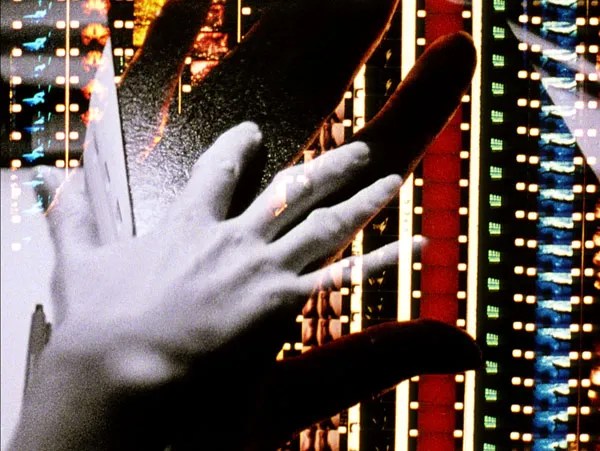
“Left Handed Memories was shot with outdated film stock on a tiny budget. There was material I shot in Baltimore when I returned from [Will’s] funeral… additional material I shot in Atlanta which became my new home… even several out-takes from Will’s works were taken from the thousands I had re-cored and labeled; and passages from prints of Will’s films ran like beautiful reminders on the bottom of the frame. I built my own copy stand… I made effects with black tape and patience.
“The sound track would begin to locate me back in the world. This film would be the first artwork where I would insist that I always remember how small I was in the global reality. On the sound track, from beginning to end, there are news stories of the day that both date and add context to the piece. Mine was a grief shared with the world… no more or less important than any other human’s. The newscasts would be mixed with tracks pulled from Will’s records and then added to a voice over that is now both embarrassing and revealing as a personal marker of that time. The result is scrappy, raw, amateur and personal.” (MF)
PRIVATE PROPERTY (PUBLIC DOMAIN) (1990)
16mm, bw & color, sound, 12m
“I made Private Property (public domain) right before I moved to Chicago. It attempted to examine the effect postmodernism was having on life in very personal terms. …it was a work that was created many years before the digital revolution and the Internet… and now it seems to exist only as a liminal indicator. But at the time, I took the exploration seriously. I knew the first printing was lacking and needed additional work. Something was missing but I couldn’t put my finger on it. I would finish it in Chicago.
“[What was missing from my film] was a ‘masculine’ current to add balance to the ‘critique’ about the particular culture/personal moment I was portraying. I had created a very ‘feminine’ space and it just wasn’t working. I asked [Zack Stiglicz] if I could record him reading the common and Latin names of seashells. He agreed.
“It was the addition of this layer of sound in Private Property that snapped the piece together for me. I ‘dismantled’ the common names of the seashells and placed them in dialog with the main voice-over and so the lyric command of the names splintered and lost both their power and beauty. This strategy did not create new meaning… it merely commented on what was there… a hollow echo. Even the ‘scientific’ Latin names seemed empty and insignificant. It was just as postmodernism had predicted and delivered. All symbols and voices of authority lost their influence. All ‘grand narratives’ were coming unraveled. Even a simple story could only be cobbled together with lines borrowed from other texts and sources. All of the on-screen text in Private Property is plagiarized or paraphrased… as is much of the spoken narrative. Additionally, the ‘main character’ in the film slips in its reference… the spoken text refers to ‘she’… the written text declares ‘I’. In short, it’s not even clear whom the film is about.
“My question was how to put meaning back… how to self-define in a time that had turned things to rubble and then created either unnecessary caution or superficial ‘copying’. Perhaps… that’s still my question.” (MF)
DEVOTIO MODERNA (1992)
16mm, bw & color, sound, 9m
“…there was a point when I thought that perhaps I could be a filmic poet. I would utilize someone else’s words and spin them in a new direction with the addition of my visuals. It was from this simple grounding that I made devotio moderna.” (MF)
ORNITHOLOGY (1995)
16mm, bw & color, sound, 20m
LIFE/EXPECTANCY (1999)
16mm, bw, sound, 30m
“Life/Expectancy meditates on a woman’s midlife search for meaning. In order to find ‘her own story’ the woman feels – in every cell of her body, to risk a cliché, – that she must find a code of memory that lies beyond herself, something that also involves a code of cultural value. The Misfits, Intolerance, Sunset Boulevard and Lady from Shanghai emerge as selected film narratives and tales from the larger culture that draw her in. As a visionary artist, she must excavate these works on her own terms. She recreates brief, captivating segments from the films in order to isolate the emotional core and fundamental impulse of storytelling that she is convinced these fragments bear. As the project unfolds, the woman finds herself necessarily drawn to other fragmentary visual frames: thorns on rose stems, light passing on the dining room floor, flip books, a film projector, bodies darting in public space, the blankness provided by a fresh snow. Drawn to these external reflections of her own demons and their uncanny power to blend inexplicably in ways that subvert and defer symbolic expectations, the woman realizes that there are no grand narratives that work for her and that the heart of midlife resides for some wanderers in glimpses of stories that refuse to be told or, apparently, in ‘footnotes’ that survive the loss of the tales with which they were once associated. This is what she has now – vibrant footnotes to life and nothing more. However, in these drifting remains with their curious capacity to blend experimentally with one another she discovers the means to sacrifice the beating warmth of a sentimental heart and to replace it with a guarded, harsh and eccentric wisdom that gives new form to the psyche.
“Life/Expectancy is a fiction. It is a non – fiction. This film is an essay. It is a bad…but beautiful… dream. This film is an experiment in poetic form. It is personal. It is about no one. Cinema is the core of exploration and it is cinema that has left her trace in a moment already gone by the time it is seen. Can a medium experience a mid – life crisis, or at a hundred years old, is she left only to curse her offsprings and die?”
…
“In Life/Expectancy I would use the movies as the repository for stories in fragmented form. After all, there had been… we had been told… ‘the death of the author.’ It was up to us now as ‘scripters’ to make meaning. So, it would seem that I picked up the strand of inquiry where I had let it go in Private Property. The contemporary story would lack completion. That lack could even be considered a ‘normalized’ state of our historic moment. Stories would have beginnings… would have ends… but no developed middle. Zack jokingly called this piece my ‘mid-life crisis film.’”
…
“In trying to foreground stories… I strip the imagery in Life/Expectancy. It’s not that there isn’t plenty to process visually, but the strategy of layering images I had used in previous works is gone… as is color. There is an extended use of time and more developed motifs within sections. The piece is organized around ‘chapters’ or sequences that try to represent different types of storytelling. None of the approaches to storytelling explored here are successful.
“I have reprinted scenes from well-known narratives… Intolerance… Lady from Shanghai… The Misfits… Sunset Boulevard. These have been re-imaged in a way to include the flicker of projection… the apparatus is not hidden. Like the flickering of the flames around a fire I wanted that essential atmosphere to be present even as the story faltered. Photographic still representations are generated from Persona… Hiroshima, Mon Amour… and some of the early actualities that appear as flipbooks. The sound track pulls on some of the most famous voices in Hollywood cinema… Marilyn Monroe… Elizabeth Taylor… Richard Burton… Jane Fonda. All ingredients come unmoored from their original source in service of creating new stories that can only be completed or inferred by each viewer. All elements are combined with the ‘wrong’ narrative and placed at odds with the definitions (which are actually quotes) that run as footnotes and are sometimes read on the soundtrack.
“Commonly we are fed the cliche, ‘A picture is worth a thousand words.’ That may have been true in the past… when images weren’t so ubiquitous. But now, any walk through life sees dozens of examples of people taking photos or information racing by in pictorial form. Pictures have taken over… a flipped problem from my interrogation and smug implications in Private Property (public domain). It isn’t pictures that are in trouble… we are awash in them… even pushed to a point of neutrality because of their abundance. The question now is about the words… the communication… the story… the articulate underpinning of thoughts. In short, how are we processing words… images… and the combination? Are we vigilant? Do we take the time to become careful readers? Do we listen? Meaning comes in multiples… are we quick enough… open enough to comprehend? Fearless enough to ask questions? Lots of them. Eloquent enough to be understood without a million misunderstandings? How often I hear people say, ‘It’s complicated.’ Life has been made all the more complicated because we don’t take the time to clearly understand or be understood, even by those who are closest to us. We don’t listen. And we expect that others should be able to clearly read our minds… we don’t speak with honesty and critical clarity. How much of what we say is really ‘between the lines?'”
*
Michele Fleming was known as Shellie to friends and her community. Her bio, ca.2000s:
Michele Fleming has made short format personal experimental films for the last twenty years. Her work has been exhibited throughout the United States and has garnered numerous prizes over the years. Despite the pressures of technology, demand for ‘production values’, or expansion into long format or expanded co – operative work, Fleming remains devoted to the ‘hand – made’ or single author approach to filmmaking. Taking on issues as wide ranging as exploration of memory and loss, the impact of AIDS on the personal psyche, the poetic rendering of the cruelest and most destructive (but often completely socially accepted) aspects of human behavior, or the notion of ‘mid – life crisis’, her films remain as traces or personal documents.
Fleming is currently an Associate Professor of Filmmaking at the School of the Art Institute of Chicago, where she has taught for the last ten years. Previous to this time she worked extensively as a curator of Film and Video.
 LIGHTSTRUCK