
If you’re really keen to dig into this with me in full nerd mode, I’d suggest consulting a reference video of the film, which I’ve posted here for convenience (+ please let me know if the link stops working):
https://vimeo.com/453804341
pw = flora
The production process of this film has been somewhat complicated to figure out, but I believe the following to be as accurate an explanation of the process as I can determine, based on my inspections of all the extant material generated in the making of this film.

Brakhage produced the raw material for this film much like he did with Mothlight, by arranging organic matter (leaves, flowers, grass, etc.) between two layers of perforated 35mm splicing tape. In other words, the organic material was not affixed to film stock, but suspended in a sandwich of adhesive splicing tape. Two rolls were produced, the larger one labeled “The Garden of Earthly Delights” (comprising the material that makes up the middle of the finished film) and the smaller one labeled “Night Blooming” (comprising the material that makes up the beginning and end sections of the film). These rolls were each optically printed in various ways at Brakhage’s lab, Western Cine, to create the material that produced the finished film. The “Night Blooming” roll seems to have actually been created first, and the film originally may have been intended to have that title, and possibly even comprise only that material. In fact, the original material and the first generation optical negative made from it have a titlecard present (which was not retained in the final film):

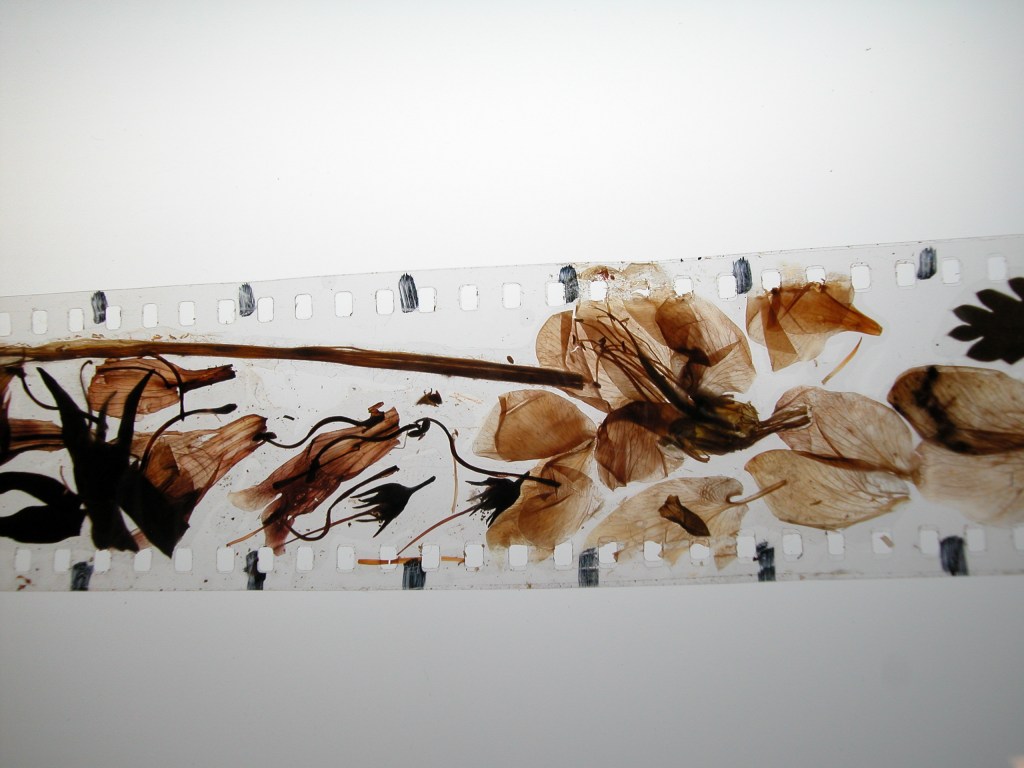
There are a couple of reasons why I think the “Night Blooming” material was created first. The simplest explanation is that the lab paperwork is suggestive of this, noting in one handwritten memo that Brakhage submitted a “2nd roll orig”, along with a “title change” to the film’s final title, along with further notes about the printing of the film’s main and end titles. Another indicator is that on the original assembled organic material for “Night Blooming”, Brakhage marked all the framelines with black magic marker across the full film strip (to help him and the lab with orientation and framing). Upon printing this material, it became clear that these frameline markings were very visible (and seemingly undesirable) in the printed result, to the degree that some cropping was done on this material in its subsequent optical printing, to make them less visible. The “Garden” roll, on the other hand, has framelines marked only at the edges, seemingly done as a revised approach to avoid this problem, like this:
Fundamentally, the finished film is structured as follows:
-Freeze-frame on hand-scratched copyright card/credit
-Hand-scratched opening title reading “The Garden of Earthly Delights”
-The film itself then opens with the “Night Blooming” material. The “Night Blooming” material is 386 frames long (ca.16 seconds), and in this opening, it is shown twice, with a 96-frame (4 second) dissolve bridging the two run-throughs of the footage. I should note here that although the content of the two run-throughs of the footage is identical, the second run-through was printed with somewhat different cropping, exposure, and color timing, so it’s not just two identical presentations of the material.
-There is then a 120-frame (5 second) dissolve from the “Night Blooming” material to the “Garden of Earthly Delights” section of the film (hereafter just “Garden” for simplicity). The “Garden” section is 660 frames long (27.5 seconds), and like “Night Blooming”, is also presented here twice, bridged by a 16-frame dissolve. However, the second half runs in reverse order from the first half, which is to say the frames are in the same pictorial orientation, but run in reverse order. They are visually identical otherwise.
-There is then a 96-frame dissolve back to a “Night Blooming” closing, which is the same 386 frames of this material again, but this time only running through once, and again with a slightly different exposure/color timing approach than the two run-throughs in the first section of the film.
-The film ends with a hand-scratched “by Brakhage” title, followed by a different freeze frame of the title and copyright year/credit.
Putting the main and end titles aside, the film essentially comprises two batches of material – the “Night Blooming” material and the “Garden” material. Besides the editorial manipulations as described above, the “Night Blooming” material in particular underwent additional optical manipulation in the form of bi-pack printing to create its unique nocturnal quality. To describe further how the film was made, I’ll talk about each section separately.
The “Garden” section of the film is relatively unmodified from the production material’s original visual appearance. The 660-frame sequence of organic material was first duplicated on the optical printer to 5247 color negative, running beginning to end, and then end back to beginning, so this first generation optical negative comprises two run-throughs of the footage – one forwards, and one backwards. This optical color negative was then printed both to 35mm 5381 color print stock, AND optically reduced to 16mm 7381 color print stock. I’ll come back to this later.
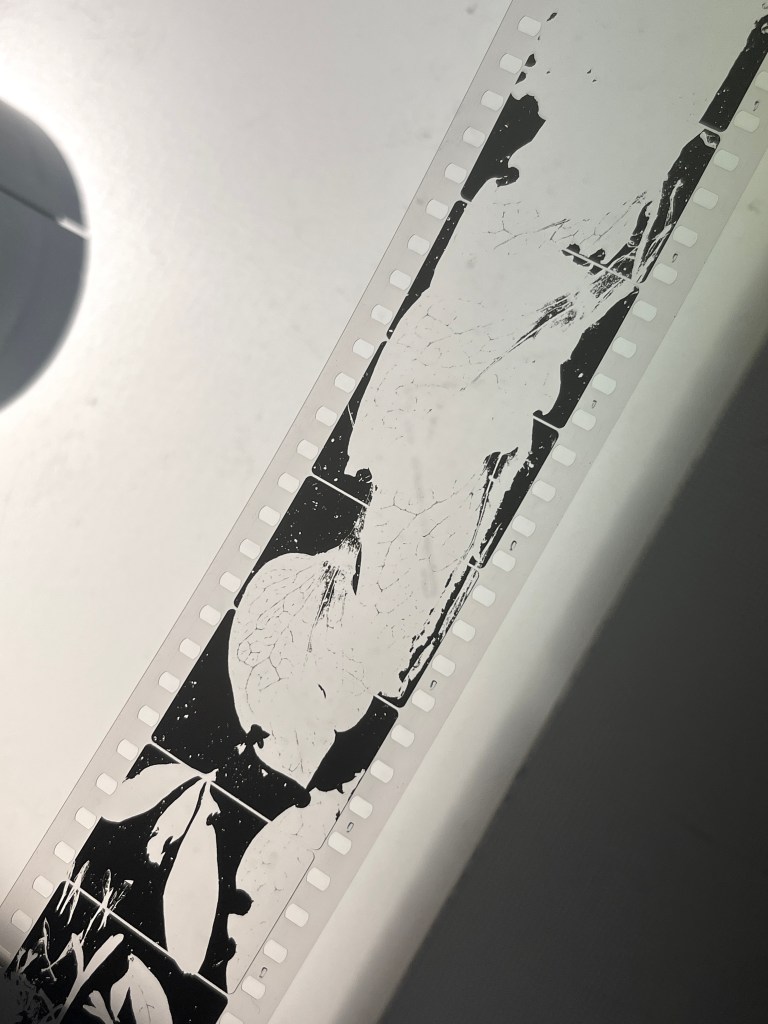
The appearance of the “Night Blooming” section that comprises the beginning and ending of the film is the result of a few steps of optical effects printing, in particular bi-packing a color positive and high contrast negative matte element (“bi-packing” refers to the physical sandwiching together of two film elements in the optical printer to then duplicate the result). As with the “Garden” sequence, the “Night Blooming” organic material was first optically duplicated to 5247 35mm color negative stock, which was then printed to 35mm 5381 color print stock. This color print was then printed to 35mm 5369 high contrast negative, essentially to create a negative hicon matte of the material:
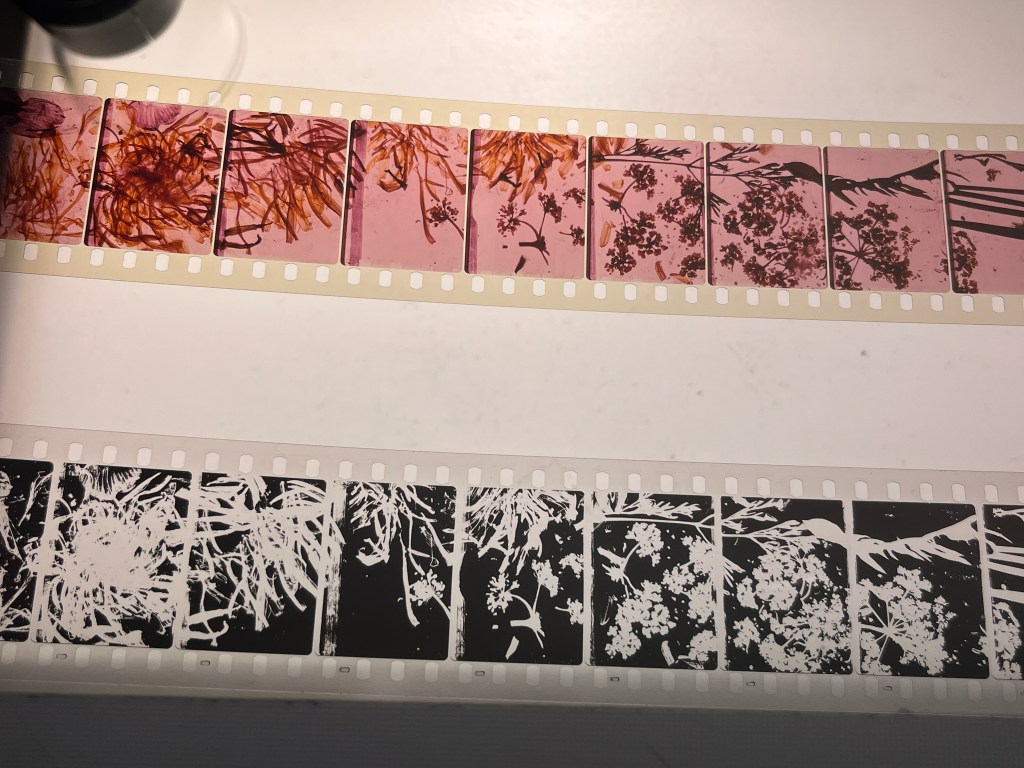
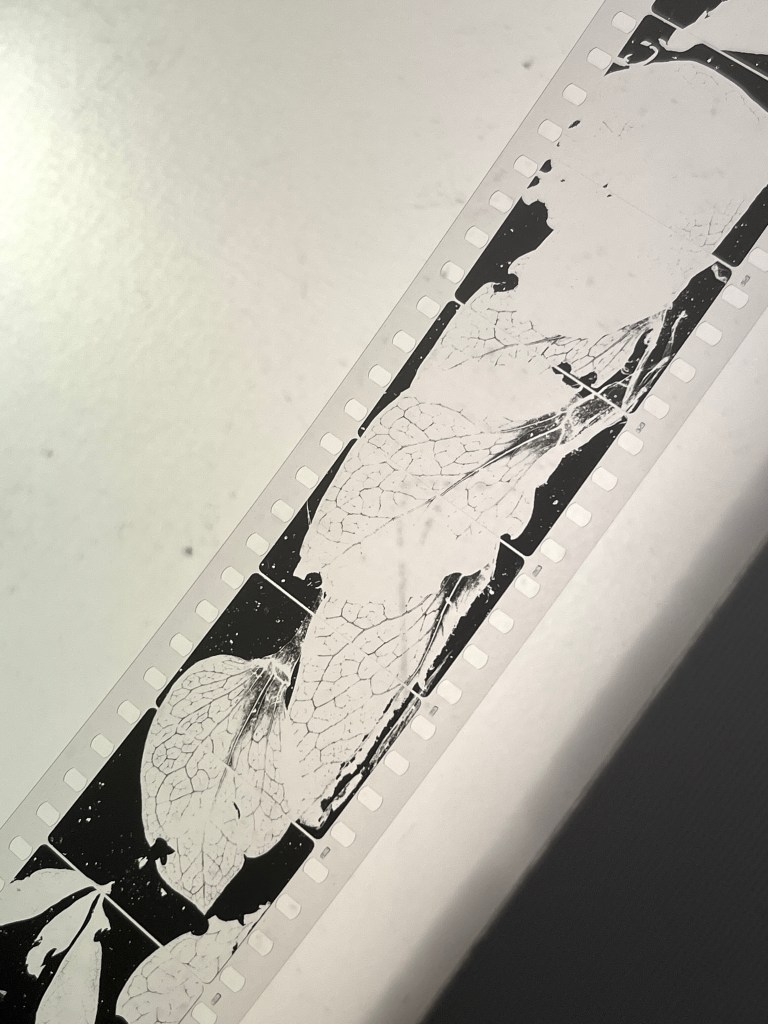
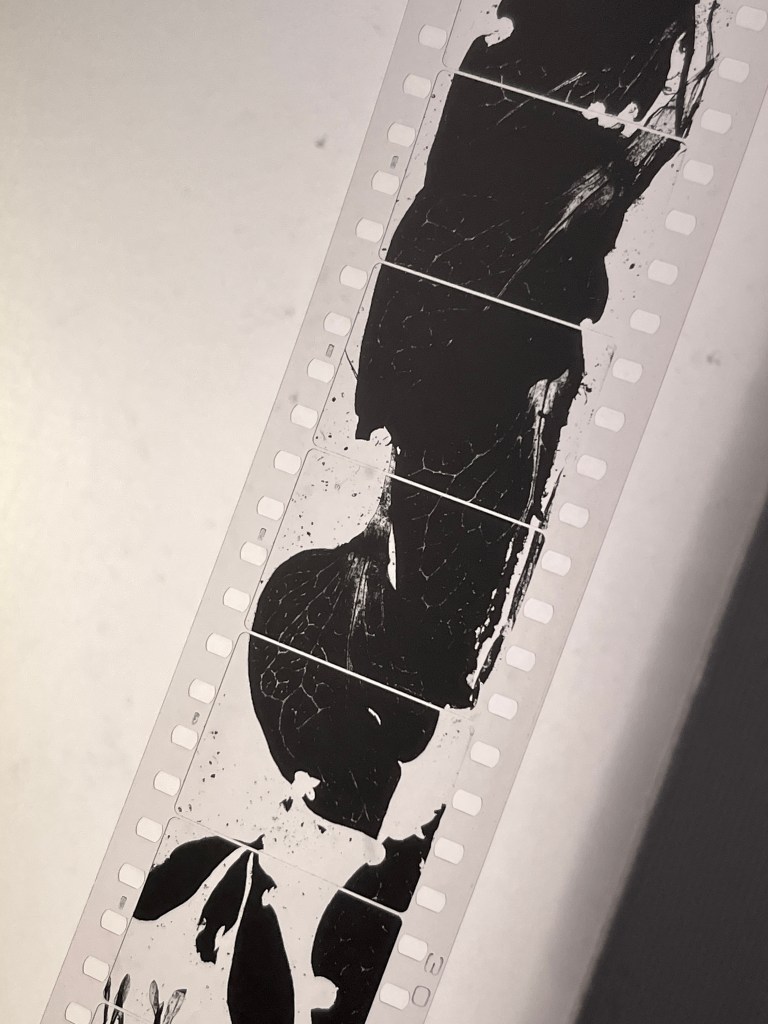
At this point, a 16mm reduction print test seems to have been produced by bi-pack printing the color print with the newly created hicon matte, but the results were deemed partly unsatisfactory by Brakhage, seemingly mostly due to issues with color. Based on his response, the lab seems to have had the feeling that the hicon matte needed to be printed another couple of generations to clear out some of the visible density still remaining in its highlights (a notation on the lab paperwork explains that “Brakhage – need wider variety of color / too green (whites) / need 2 more matte generations to clear out”). To hopefully achieve a more desirable result, this hicon negative was itself printed to 35mm 5369 hicon positive, and this positive printed AGAIN to make a 3rd generation 35mm 5369 hicon negative, which was deemed a more successful result. Here are pictures of these three generations of 5369 hicon mattes. The first picture is of the 1st generation negative matte, the 2nd is the 2nd generation positive matte, and the 3rd is the 3rd generation negative matte. In comparing the two negative mattes, you can particularly see how the extra two generations gave a more “cleared out” result in the whites, to allow for more effective and vivid windowing of the color image in the bi-pack:
What seems to have happened next is that the optical printer operator at Western Cine, Sam Bush, then bi-packed the initial 5381 color print with the new 3rd generation 5369 hicon negative copy, and printed the result multiple ways to a 16mm 7252 Ektachrome Commercial (ECO) reduction. A 16mm 7390 Ektachrome print was struck from this ECO reduction for Brakhage to evaluate and ultimately edit with (the print-through edge numbers on this 7390 material confirms that at least three of these “Night Blooming” variations were printed at the same time, as the edge numbers are nearby but non-matching on each variation). A memo from the lab indicates that in total, at least five different approaches to optically printing were taken for “Night Blooming”:
#1: full frame
#2: cropped more + for Academy aspect ratio (“crop, to avoid marked fr. lines”)
#3: same as #2, but slightly less green
#4: same as #3, but somewhat different timing lights
#5: same as #4, but “brighter”
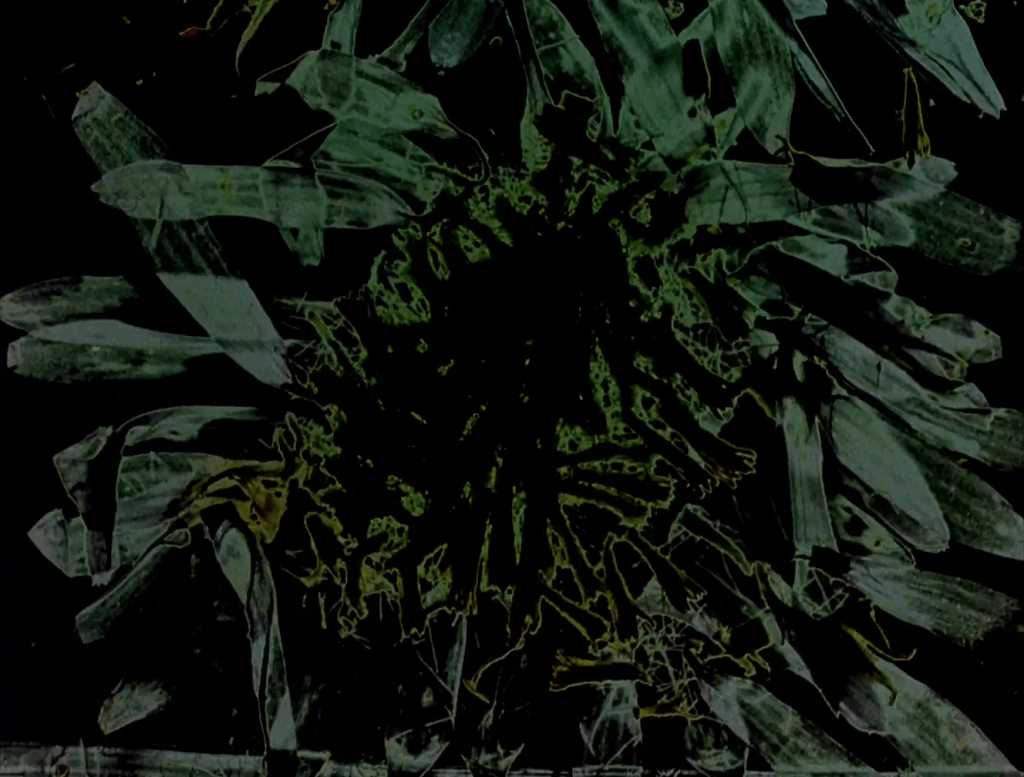
Here is the same frame of material as it appears three different times in the finished film, going left to right in the order of appearance (1st and 2nd are from the opening of the film, 3rd is from the closing):
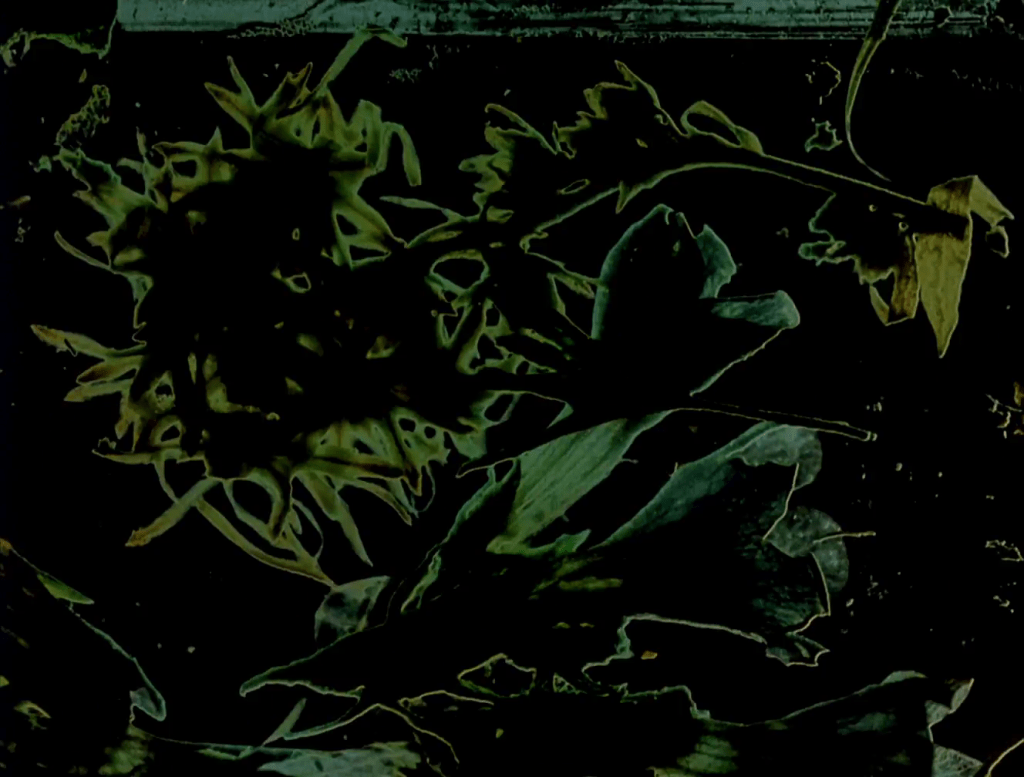
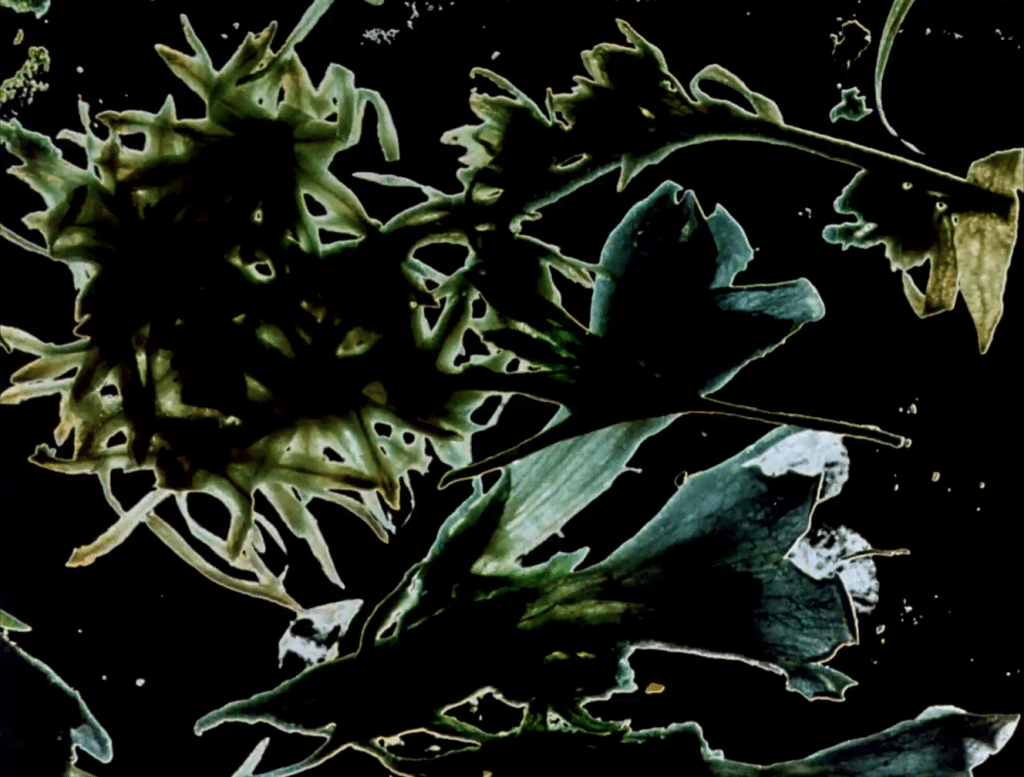
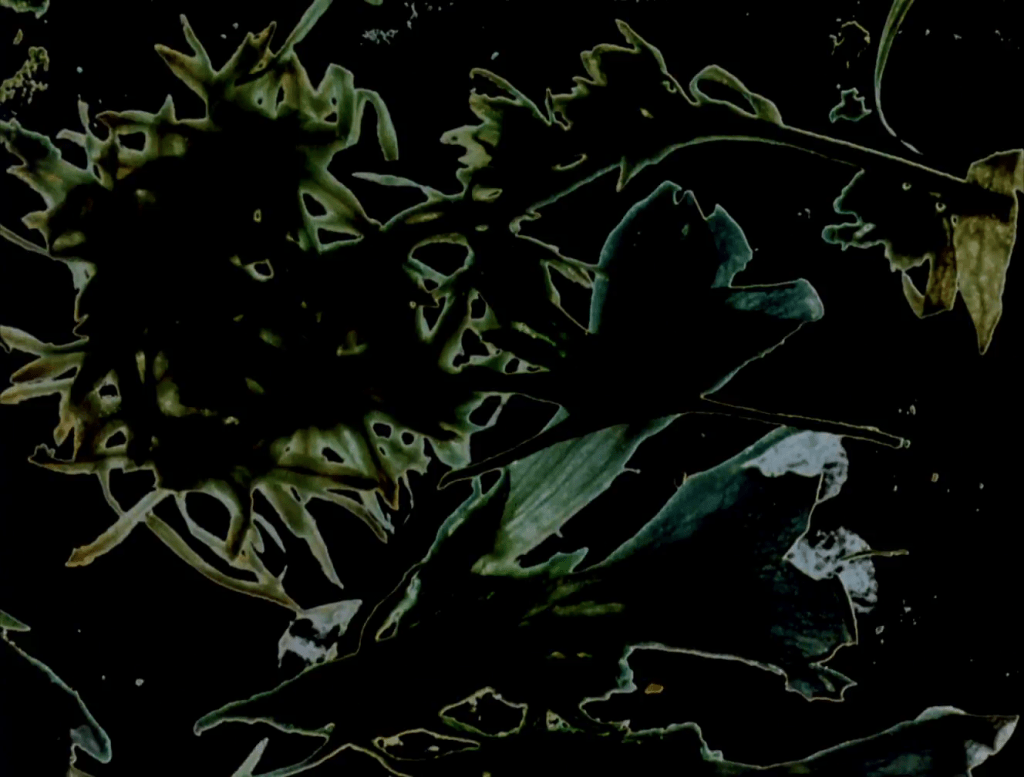
The second and third are cropped tighter (fairly identically), and all three have different color timing – the 1st is dimmer and greener, the 3rd is brighter and less green, and the 2nd is about the same as the 3rd but even brighter. Based on the final optical cue sheets for the final optical printing and assembly for the film, the 1st run-through seems to be actually the initially “rejected” approach represented by #1 in the memo above (1st generation hicon matte printed with color pos, full aperture without extra cropping), the 2nd run-through is apparently #5 from the memo (using 3rd generation matte, less green, and brighter), and the 3rd/final run-through is #4 (using 3rd generation matte, less green, but not as bright). (By the way, I posted a video describing some of this process HERE and at about the 4-minute mark it also includes demonstration of how the bi-packing looks when the two layers are brought together.)
Although it’s curious that Brakhage ended up embracing what was initially a somewhat rejected approach (less cropped, more green, more dim) for the first run-through of the “Night Blooming” material in the film, I can also imagine him being interested in the metaphorical qualities of the material starting out subdued, and brightening substantially before then dissolving to the “Garden” material in the middle of the film. But it definitely remains mysterious that he would expressly accept the less tight cropping of the 1st run-through, given that the hand-marked framelines are occasionally visible in the first section of the film (you can see them in these frames from the finished film, showing as light/negative versus black/positive, due to the hicon negative matte):


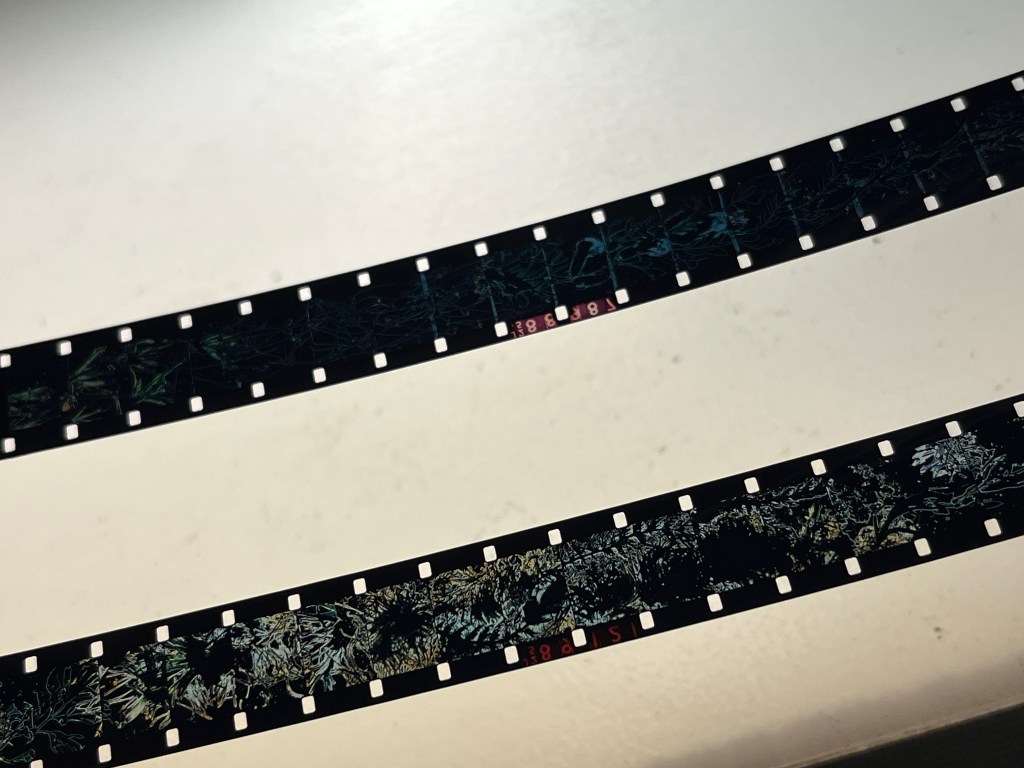
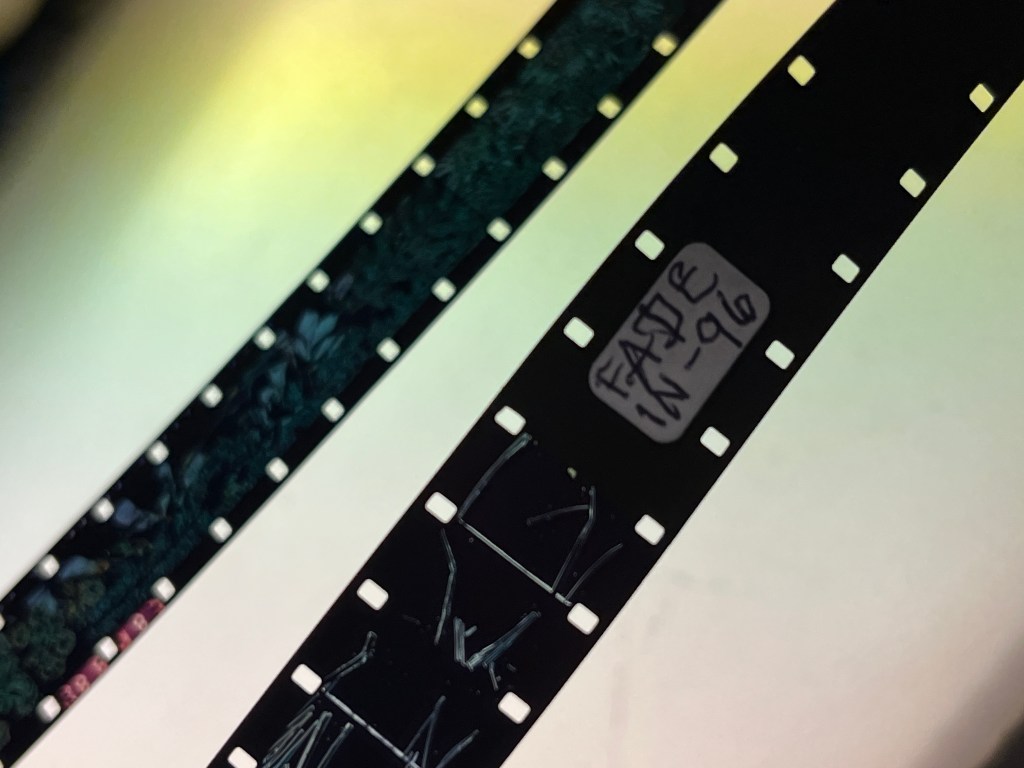
Getting back to the 16mm reductions that were mentioned earlier – the reason both the “Garden” and “Night Blooming” sections were reduced to 16mm in this part of the production process seems to be so Brakhage could then use those materials for editing. He didn’t have the means to edit 35mm, and was much more accustomed to edit 16mm anyway, and so I believe these reductions were made purely so Brakhage could finalize the film’s edit. There is a set of 16mm A/B rolls in his collection that reflect this editing process, and are made up entirely from reduction 7381 color print (“Garden”) and 7390 color reversal print (“Night Blooming”) material. They have fade lengths noted on them, and differ in a few very minor ways from the finished film, which shows that the A/B rolls themselves were not actually used for further printing, but just for Brakhage’s editing purposes, much like a workprint:



I believe what then happened is that Brakhage’s A/B rolls went back to Western Cine to be used as a guide for the optical completion of the 35mm film. Sam Bush would have used the initial 35mm 5381 print of the “Garden” section, along with the 35mm bi-pack elements (1st and 3rd generation hicon negatives + color print) of the “Night Blooming” section, and printed them all per Brakhage’s approvals and preferences (especially with regard to exposure and cropping in “Night Blooming”). In this process, Sam would have also created the main and end title freeze frames from Brakhage’s scratched original, resulting in a fully conformed 5247 “original negative” for the film. There are actually no physical splices in this finished original optical negative, as Sam would have done all the optical printing needed in multiple steps to create a conformed negative entirely on the printer, without the need for editorial assembly after. As impressive as that sounds, it was extremely common for Sam to do sometimes even much more elaborate optical printing work on Brakhage’s hand-painted films entirely “in-camera” on the printer, resulting in conformed original negatives with no need for splicing.


 LIGHTSTRUCK